
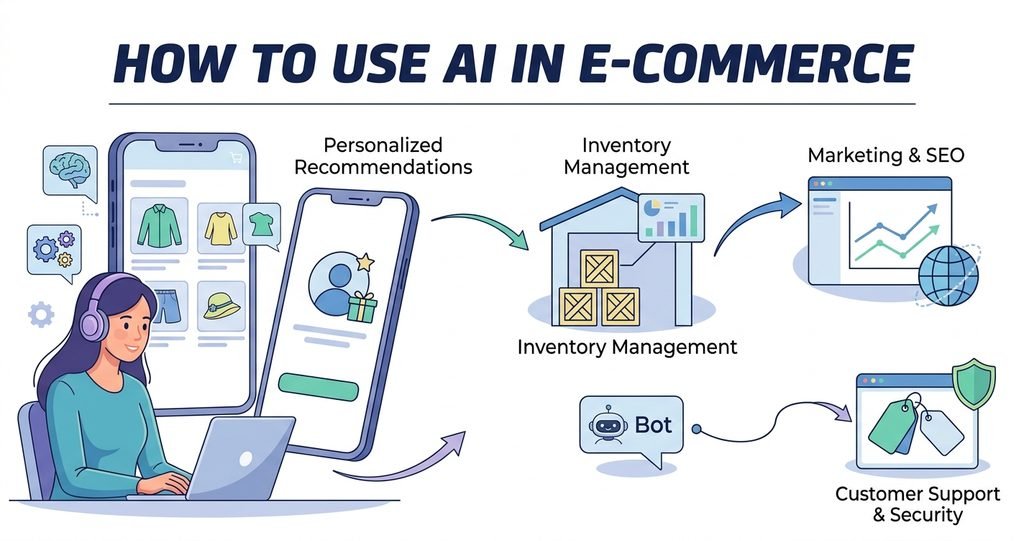
Table of Contents
Artificial intelligence (AI) Artificial intelligence (AI) is changing the way online businesses attract customers, manage operations, and increase sales. From writing product descriptions to answering customer questions, AI can automate many repetitive tasks and help e-commerce businesses make better decisions.
If you’re wondering how to use AI in e-commerce, there are several practical ways to implement it without completely changing your existing business model. Understanding how to use AI in e-commerce can help you identify the right opportunities for automation, personalization, marketing, and business growth.
In this guide, we’ll explore 10 practical AI use cases in e-commerce and explain how to use AI in e-commerce for marketing, SEO, customer service, product recommendations, inventory management, analytics, and other important areas of your online store.
If you’re wondering how to use AI in e-commerce, there are several practical ways to implement it without completely changing your existing business model. The right AI tools can help you save time, personalize the customer experience, improve marketing campaigns, and make your online store more efficient.
In this guide, we’ll explore 10 practical AI use cases in e-commerce, along with the benefits, tools, and steps you can take to start using AI in your own online store.
What Is AI in E-commerce?
AI in e-commerce refers to using artificial intelligence technologies to automate tasks, analyze data, understand customer behavior, and improve different parts of an online shopping business.
AI can process large amounts of information much faster than humans. This makes it useful for tasks such as product recommendations, customer support, demand forecasting, content creation, and marketing optimization.
For example, an online store can use AI to recommend products based on a customer’s browsing history or automatically generate descriptions for hundreds of products.
How Can AI Be Used in E-commerce?
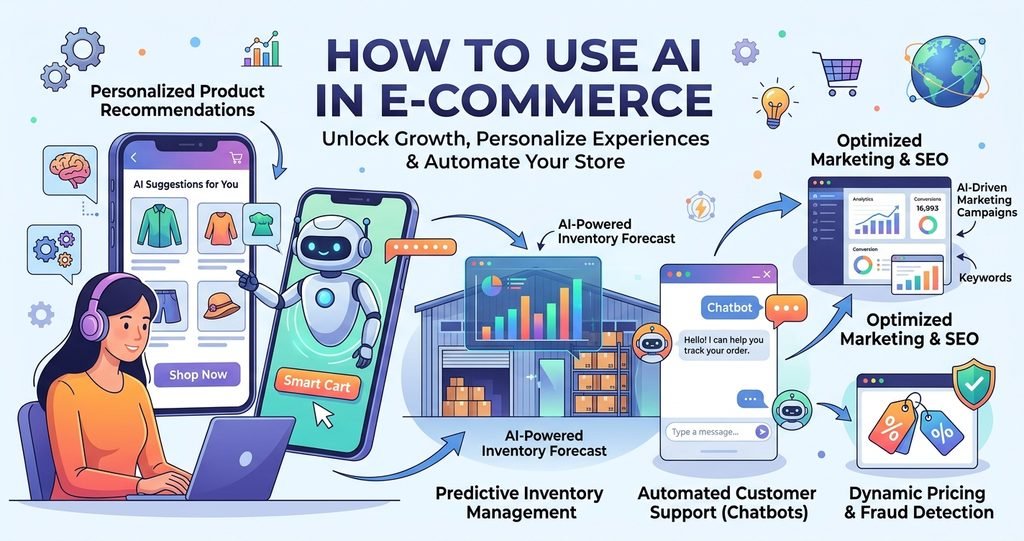
There are many ways businesses can use artificial intelligence to improve their online stores. Some applications focus on increasing sales, while others help reduce workload and improve customer satisfaction. Before implementing artificial intelligence, it’s important to understand how to use AI in e-commerce based on your specific business goals. A small online store may benefit most from AI content creation and customer support, while a larger e-commerce company may focus on personalization, predictive analytics, and inventory automation.
The key is to start with practical applications that solve real problems instead of adding AI simply because the technology is popular.
Here are 10 practical ways to use AI for e-commerce:
How to Use AI in E-commerce for Marketing
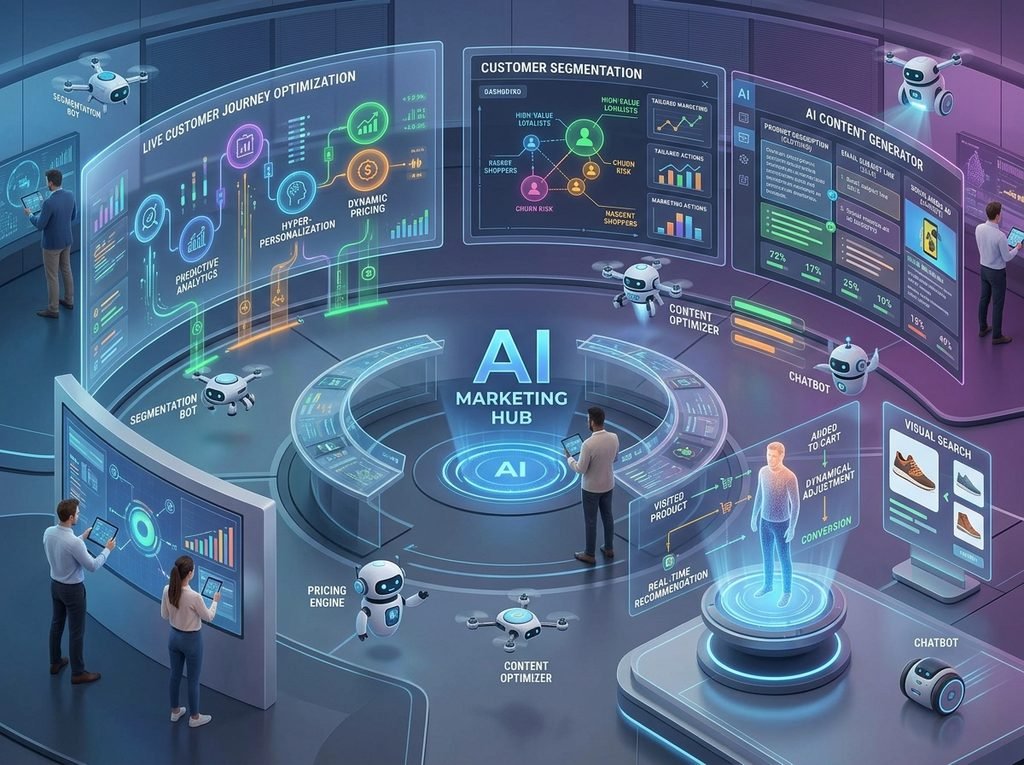
Marketing is one of the easiest areas where businesses can start using AI. AI-powered tools can help create content, analyze campaigns, research customers, and optimize marketing strategies. Knowing how to use AI in e-commerce for marketing can also help businesses create more targeted campaigns. AI can analyze customer behavior, identify audience segments, and assist marketers with personalized content and advertising ideas.
1. Use AI to Create Product Descriptions
Writing product descriptions for hundreds of products can take a significant amount of time. AI writing tools can help e-commerce businesses create product descriptions quickly while maintaining a consistent brand voice.
You can provide information such as:
- Product name
- Features
- Benefits
- Materials
- Target customer
- Product specifications
- Brand tone
AI can then create an initial product description that you can review and edit before publishing.
However, businesses should avoid publishing AI-generated content without checking it. Product information should always be accurate and match the actual product.
2. Use AI for E-commerce SEO
Search engine optimization is important for attracting organic traffic to an online store. AI can assist with several parts of e-commerce SEO, including keyword research, content planning, title generation, product descriptions, and content optimization.
For example, AI can help you identify relevant keywords such as:
- AI for e-commerce
- AI e-commerce tools
- online store automation
- e-commerce marketing
- AI product recommendations
AI can also help create content outlines and identify questions that potential customers may search for.
The goal should be to use AI as an assistant rather than replacing human SEO strategy completely.
3. Use AI for E-commerce Marketing
AI can help marketers analyze customer data and create more personalized marketing campaigns.
For example, an e-commerce business can use AI to identify customer segments based on:
- Purchase history
- Browsing behavior
- Location
- Interests
- Average order value
- Product preferences
These insights can help businesses create more relevant email campaigns, advertisements, social media content, and promotional offers.
AI can also help marketers generate multiple ad copy variations and content ideas, allowing them to test different approaches more efficiently.
4. Personalize the Shopping Experience
Personalization is another important application of AI in online shopping.
Instead of showing the same products to every visitor, an AI-powered system can analyze customer behavior and provide more relevant recommendations.
For example, if someone frequently views running shoes, the website could recommend related products such as running socks, sportswear, or fitness accessories.
Personalization can make the shopping experience more relevant and help customers discover products they may actually want.
5. Use AI for E-commerce Customer Service
Customer support can become difficult to manage as an online store grows. AI chatbots can help answer common customer questions at any time of the day.
An AI customer service system can assist with questions about:
- Order status
- Shipping information
- Return policies
- Product availability
- Store policies
- Frequently asked questions
More complicated issues can then be transferred to a human support representative.
This type of e-commerce automation with AI can reduce repetitive support work while allowing human employees to focus on more complex customer problems.
6. Use AI for Product Recommendations
Product recommendations are one of the most recognizable AI applications in e-commerce.
AI systems can analyze customer behavior and recommend products based on previous interactions.
For example:
A customer purchases a smartphone. The system may recommend a phone case, screen protector, charger, or wireless earbuds.
Recommendations can appear on product pages, shopping carts, homepages, and follow-up emails.
When implemented correctly, personalized recommendations can help customers find relevant products more easily.
7. Use AI for Inventory Management and Demand Forecasting
Managing inventory is a major challenge for e-commerce businesses. Keeping too much inventory can increase storage costs, while keeping too little can lead to stockouts.
AI can analyze historical sales data, seasonal trends, product demand, and other business information to help estimate future demand.
For example, an online clothing store could analyze previous sales to identify which products are likely to become more popular during a particular season.
AI-based forecasting doesn’t guarantee perfect predictions, but it can provide useful information for inventory planning.
8. Analyze E-commerce Data With AI
E-commerce businesses generate large amounts of data every day. This includes website visits, sales, advertising performance, customer behavior, and product performance.
AI can help turn this data into useful insights.
You can use AI to analyze questions such as:
- Which products generate the most revenue?
- Which marketing channels bring the most customers?
- Where are customers abandoning their carts?
- Which products have declining sales?
- Which customer segments spend the most?
These insights can support better business decisions and help identify areas that need improvement.
9. Automate Repetitive E-commerce Tasks
Many e-commerce tasks are repetitive and time-consuming. AI and automation tools can reduce the amount of manual work required.
Examples include:
- Generating content ideas
- Categorizing products
- Drafting customer responses
- Creating email campaigns
- Summarizing customer feedback
- Organizing product information
- Analyzing reports
- Creating social media content
The purpose of automation isn’t necessarily to eliminate human involvement. Instead, it can give business owners and employees more time to focus on strategy, creativity, and customer relationships.
10. Use ChatGPT for E-commerce
ChatGPT can be used for many different e-commerce tasks. It can help business owners and marketers brainstorm ideas, create drafts, analyze information, and develop marketing content.
For example, you can use ChatGPT to:
- Write product description drafts
- Generate blog post ideas
- Create social media captions
- Develop email marketing ideas
- Brainstorm advertising concepts
- Create customer service response templates
- Research content topics
- Build FAQ ideas
- Create SEO content outlines
When learning how to use AI in e-commerce, ChatGPT can be a useful starting point because it can support many different tasks from a single platform.
However, always review AI-generated information before publishing it or using it for business decisions.
Benefits of AI in E-commerce
Using AI can provide several potential benefits for online businesses.
Save Time
AI can automate repetitive tasks and help teams complete certain jobs faster.
Improve Customer Experience
Personalized recommendations and faster customer support can create a smoother shopping experience.
Make Better Data-Driven Decisions
AI can process large amounts of business data and identify patterns that may be difficult to detect manually.
Increase Marketing Efficiency
AI can help marketers create content, analyze campaigns, segment customers, and test different ideas.
Scale Business Operations
Automation can help businesses handle a growing number of products, customers, and marketing activities without increasing manual work at the same rate.
What AI Tools Are Best for E-commerce?
The best AI tool depends on the specific problem you’re trying to solve. Instead of choosing a tool simply because it uses AI, consider what your business actually needs.
Common categories include:
- AI writing assistants
- AI customer service chatbots
- AI product recommendation systems
- AI SEO tools
- AI analytics platforms
- AI advertising tools
- AI inventory forecasting software
- AI image-generation tools
- AI email marketing platforms
For a small online store, starting with one or two tools may be more practical than implementing multiple AI systems at once.
How to Start Using AI in Your E-commerce Business
You don’t need to automate your entire online store immediately. A gradual approach is usually easier to manage.
Step 1: Identify Repetitive Tasks
Look for tasks that take a lot of time but don’t require significant human creativity.
Step 2: Choose One Problem
Start with a specific goal, such as improving product descriptions, customer support, or content creation.
Step 3: Select an Appropriate AI Tool
Choose a tool that matches your business requirements, budget, and existing technology.
Step 4: Test the Results
Run a small test before implementing AI across your entire store.
Step 5: Review and Optimize
Monitor the results and make adjustments based on performance and customer feedback.
This approach makes it easier to understand how to use AI in e-commerce effectively while minimizing unnecessary costs and operational problems.
Common Mistakes When Using AI in E-commerce
AI can be powerful, but it should not be treated as a replacement for human judgment.
Some common mistakes include:
Publishing AI Content Without Reviewing It
AI-generated content can contain incorrect or outdated information. Always review important content before publishing.
Using AI Without a Clear Goal
Implementing AI simply because it is popular can waste money and time. Start with a specific business problem.
Ignoring Customer Privacy
Businesses should handle customer information responsibly and follow applicable privacy and data-protection requirements.
Automating Everything
Some customer interactions require empathy, context, and human judgment. Keep human support available when necessary.
Focusing Only on Automation
The purpose of AI should be to improve business performance and customer experience, not simply to automate as many tasks as possible.
The Future of AI in E-commerce
AI is likely to become increasingly integrated into online shopping and e-commerce operations.
Future applications may include more advanced personalization, conversational shopping assistants, automated content creation, predictive analytics, intelligent search, and more efficient inventory management.
As AI technology develops, businesses will have more opportunities to use customer and business data to create personalized experiences and improve operational efficiency.
However, successful AI adoption will still require human oversight, good-quality data, clear business goals, and responsible implementation.
Frequently Asked Questions
How can AI be used in e-commerce?
AI can be used for product descriptions, SEO, marketing, customer service, product recommendations, inventory forecasting, data analysis, and task automation.
How can AI increase e-commerce sales?
AI can potentially support sales by improving personalization, product recommendations, marketing campaigns, customer service, and conversion-focused experiences.
What are the uses of AI in e-commerce?
Common uses include personalized recommendations, chatbots, demand forecasting, content creation, customer segmentation, analytics, SEO, and marketing automation.
How can AI improve the customer experience?
AI can provide faster responses, personalized product recommendations, intelligent search, and more relevant shopping experiences.
How can I use ChatGPT for e-commerce?
You can use ChatGPT to brainstorm product content, create marketing drafts, develop social media ideas, prepare customer support responses, and create SEO content outlines.
How to Use AI in E-commerce Successfully
The most effective way to learn how to use AI in e-commerce is to begin with one specific business objective. Instead of introducing multiple AI tools at once, choose an area such as content creation, customer service, SEO, or marketing automation and measure the results.
Once you understand what works for your store, you can gradually expand AI into other areas of your e-commerce operations.
Final Thoughts
Learning how to use AI in e-commerce doesn’t mean you need to replace your entire business system with artificial intelligence. Instead, start by identifying repetitive tasks and areas where better data or automation could create value.
AI can support product content, SEO, marketing, customer service, personalization, inventory planning, analytics, and many other areas of an online store.
The most effective approach is to start small, test your results, maintain human oversight, and gradually expand the use of AI as your business needs evolve.
For e-commerce businesses, AI is best viewed as a tool that helps people work smarter—not as a replacement for good strategy, creativity, and customer understanding.